
Behavioral Responses to Environmental Emergency Alerts and Temporary Driving Restrictions: Evidence from Cyclists in Mexico City
- José Eduardo Castro Pérez(corresponding author),
- Daniel Flores
- ,
- Universidad Autónoma de Nuevo León
Research Output:
Contribution to journal
Article
Peer-reviewSustainable Development Goals
 SDG 11 Sustainable Cities and Communities
Publication metrics
PlumX, opens in new tab
Captures
1
Citations
1
Abstract
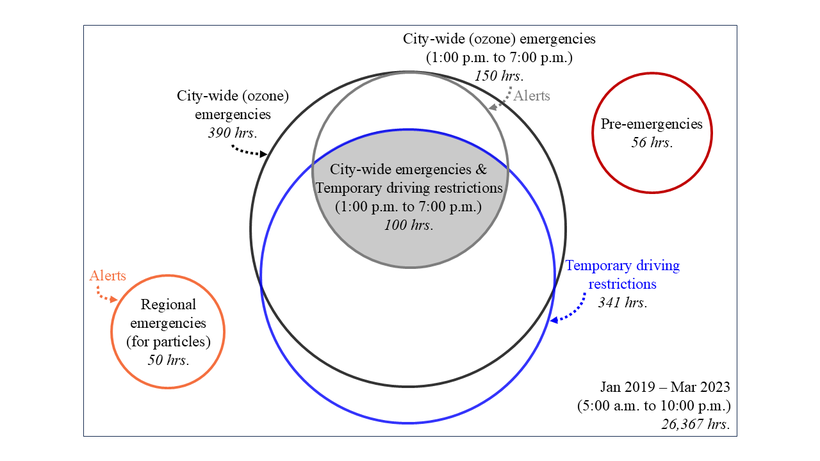
We evaluate the impact of environmental emergency alerts and temporary driving restrictions on cycling activity in Mexico City for the period 2019–2023. Although environmental alerts and driving restrictions are closely linked, they do not necessarily occur simultaneously. We are careful to disentangle their differentiated effect using an administrative dataset that allows us to distinguish cyclists’ trip purposes as commuting and leisure. We find that environmental alerts are effective, yet limited, persuading cyclists to reduce their cycling activity by about 6–29% during highly polluted days. Moreover, we confirm that temporary driving restrictions are effective, increasing commuting cycling activity in a range of 4–15%. However, the effectiveness of driving restrictions is achieved at the expense of lower-income commuters. While higher-income commuters continue to drive thanks to their greater availability of cars, lower-income commuters are pushed to opt for cleaner means of transportation—such as bicycles—at a higher cost for their health.
Publication Information
Output type
Research Output:
Contribution to journal
Article
Peer-reviewOriginal language
EnglishPages from-to (Number of pages)
Pages 1719–1771Journal (Volume, Issue Number)
Environmental and Resource Economics (Volume 88)Publication milestones
- Published - 2025
Publication status
Published - 2025